The short answer
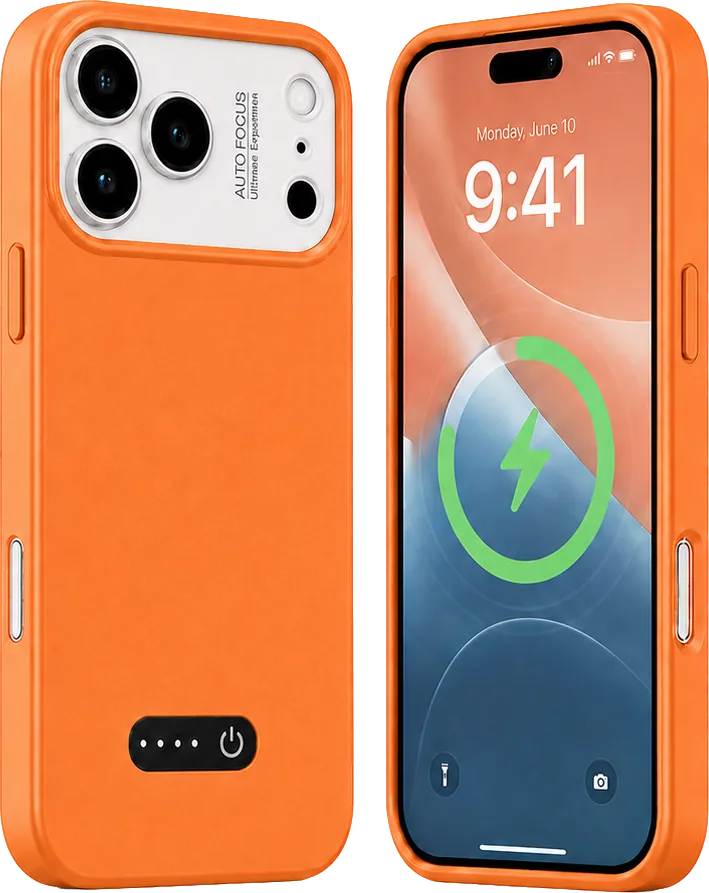
- Buy for your exact model. An iPhone 17, 17 Pro and 17 Pro Max battery case are three different shells. Cases are not interchangeable between them, or with the iPhone 16 series.
- Judge capacity by the measured number, not the rated one. Ask what the cell actually delivers and how much charge that adds to your model.
- Expect a top-up, not a second phone battery. A slim iPhone 17 battery case typically adds around a third of a charge; doubling your battery life needs a much heavier case or a large magnetic battery pack.
- Look for heat control and a UN 38.3 report. Those two things separate a well-engineered battery case from a cheap one.
Know your iPhone 17 battery
Apple publishes the battery capacity of every iPhone 17 model on its EU energy labels. These numbers decide how far any iPhone 17 battery case will take you, because the same case adds a smaller percentage to a bigger battery.
| Model | Battery capacity | Approx. energy |
|---|---|---|
| iPhone 17 | 3,692 mAh | about 14.2 Wh |
| iPhone 17 Pro | 4,252 mAh | about 16.4 Wh |
| iPhone 17 Pro Max | 5,088 mAh | about 19.6 Wh |
| iPhone Air | 3,149 mAh | about 12.1 Wh |
Energy is approximated at a 3.85 V nominal voltage. The iPhone Air uses a very different, much thinner body, so it needs its own dedicated case design.
Rated vs measured capacity
The number printed on a battery case box is usually the rated capacity of the cell, the figure the cell maker guarantees under standard test conditions. The measured capacity is what the cell actually delivers on a test bench. The two are rarely the same, and many listings never mention the second one.
On our Slim 2500, the cell is rated at 2,500 mAh and delivers 2,100 mAh on our bench. The Pro Max version is rated at 3,000 mAh and measures 2,600 mAh. We publish both numbers because the measured one is what decides how much charge reaches your phone.
Rule of thumb: if a seller cannot tell you the measured capacity, ask for the UN 38.3 test summary. It names the cell and its rated capacity, which at least lets you check the box is honest.
How much charge you will really get
Two losses sit between the cell and your phone: the converter that raises the cell voltage, and the wireless coil. On our bench, roughly 58% of the energy the cell delivers ends up in the phone battery. With that, the maths for any iPhone 17 battery case is simple: measured mAh × 3.7 V × 0.58, divided by the phone's watt-hours.
| Model | Slim 2500 version | Charge added | Slim 3600 · 3,500 mAh measured |
|---|---|---|---|
| iPhone 17 | 2,500 mAh rated / 2,100 mAh measured | about 32% | about 53% |
| iPhone 17 Pro | 2,500 mAh rated / 2,100 mAh measured | about 27% | about 46% |
| iPhone 17 Pro Max | 3,000 mAh rated / 2,600 mAh measured | about 28% | about 38% |
That is why the Pro Max version carries a bigger cell: without it, the largest phone would get the smallest top-up. For more in the same 15.5 mm shell, the Slim 3600 carries a 3,600 mAh cell (3,500 mAh measured) on every model. If you need closer to a full extra charge, look at a 5,000 mAh case such as the Pro 5000 or a magnetic battery pack, and accept the extra weight.
Fit, camera and button protection
Every iPhone 17 model has its own outline and camera plateau, so a properly made battery case is moulded per model. When you compare cases, check three details:
- Camera bezel. The camera should sit inside a raised lip, not just behind a hole. Ours is raised 0.8 mm.
- Screen lip. A lip of around 0.6 mm above the glass protects the screen when the phone lands face down and still clears most screen protectors.
- Buttons and ports. Cut-outs should match the exact model. A case shared across two generations usually gets one of them slightly wrong.
An iPhone 16 battery case will not fit an iPhone 17 properly. Even where the size is close, the camera and button positions move between generations.
Thickness and weight
A slim battery case adds capacity by adding thickness, so compare the two together. Our iPhone 17 and 17 Pro versions measure 152.5 × 75 × 15.5 mm and weigh 95 g; the 17 Pro Max version measures 165 × 82 × 15.5 mm and weighs 115 g. Be cautious with listings that claim very high capacity in a very light case: energy scales with the mass of the cell, so the numbers should rise together.
Wireless, wired and pass-through charging
Most current iPhone 17 battery cases charge the phone over a Qi coil, typically at up to 15 W. The iPhone 17 family supports faster Qi2 25W charging from certified chargers, but a battery case is limited by its own coil and cell, so do not expect charger speeds from a case.
A USB-C port with pass-through charging is worth having. Plug a cable into the case and it charges the phone and then itself, and the cable skips the coil, which is the largest single loss. Ours accepts USB-C input and delivers up to 22.5 W over the cable.
Heat and battery health
Heat is what ages a lithium battery, in the case and in the phone. Look for a battery case that measures cell temperature and reduces power when it gets warm. Ours steps down from 15 W to 7.5 W above 45 °C and stops at 100% instead of trickle charging. Avoid charging in direct sun, under a pillow, or while playing demanding games. If your iPhone offers a charge limit setting, using it alongside a battery case is a sensible way to reduce time spent at full charge.
Safety documents and air travel
A battery case is a lithium battery product, so a reputable maker can show a UN 38.3 test summary for transport, an IEC 62133 cell safety report and a safety data sheet (SDS). For travel, the rule is simple: battery cases and other spare lithium batteries belong in your carry-on, not checked luggage. A 2,500 mAh case is about 9.3 Wh, far below the 100 Wh cabin limit.
Buying checklist
- The case is made for your exact iPhone 17 model.
- The seller states both rated and measured capacity.
- The charge added is stated for your model, with test conditions.
- The camera has a raised bezel and the screen has a lip.
- There is temperature control and a USB-C pass-through port.
- UN 38.3, IEC 62133 and SDS are available on request.
Frequently asked questions
Will an iPhone 16 battery case fit an iPhone 17?
No. The outline, camera plateau and button positions change between generations, so you need a case moulded for the iPhone 17 model you own.
How much battery does an iPhone 17 battery case add?
It depends on the measured capacity of the case and the size of your phone battery. Our Slim 2500 adds about 32% to an iPhone 17, 27% to a 17 Pro and 28% to a 17 Pro Max with its 3,000 mAh version.
Is it safe to leave a battery case on overnight?
Yes, if the case has temperature control and stops charging at 100%. Keep the phone somewhere it can shed heat, not under a pillow.
How long does a battery case last?
A good cell keeps at least 80% of its capacity after 500 full cycles. For most people that is two years or more of daily use.