The short answer
- Pick a magnetic battery pack if you charge your iPhone overnight and only run out on travel days, long shifts or festivals. On normal days you carry a thin case and leave the pack at home.
- Pick a battery case if you run low every single day. One piece, nothing to forget, and the lightest way to carry each mAh.
- Neither is more efficient. Both deliver power through the same kind of wireless coil, so both lose a similar share of energy on the way into the phone.
What is a magnetic battery pack?
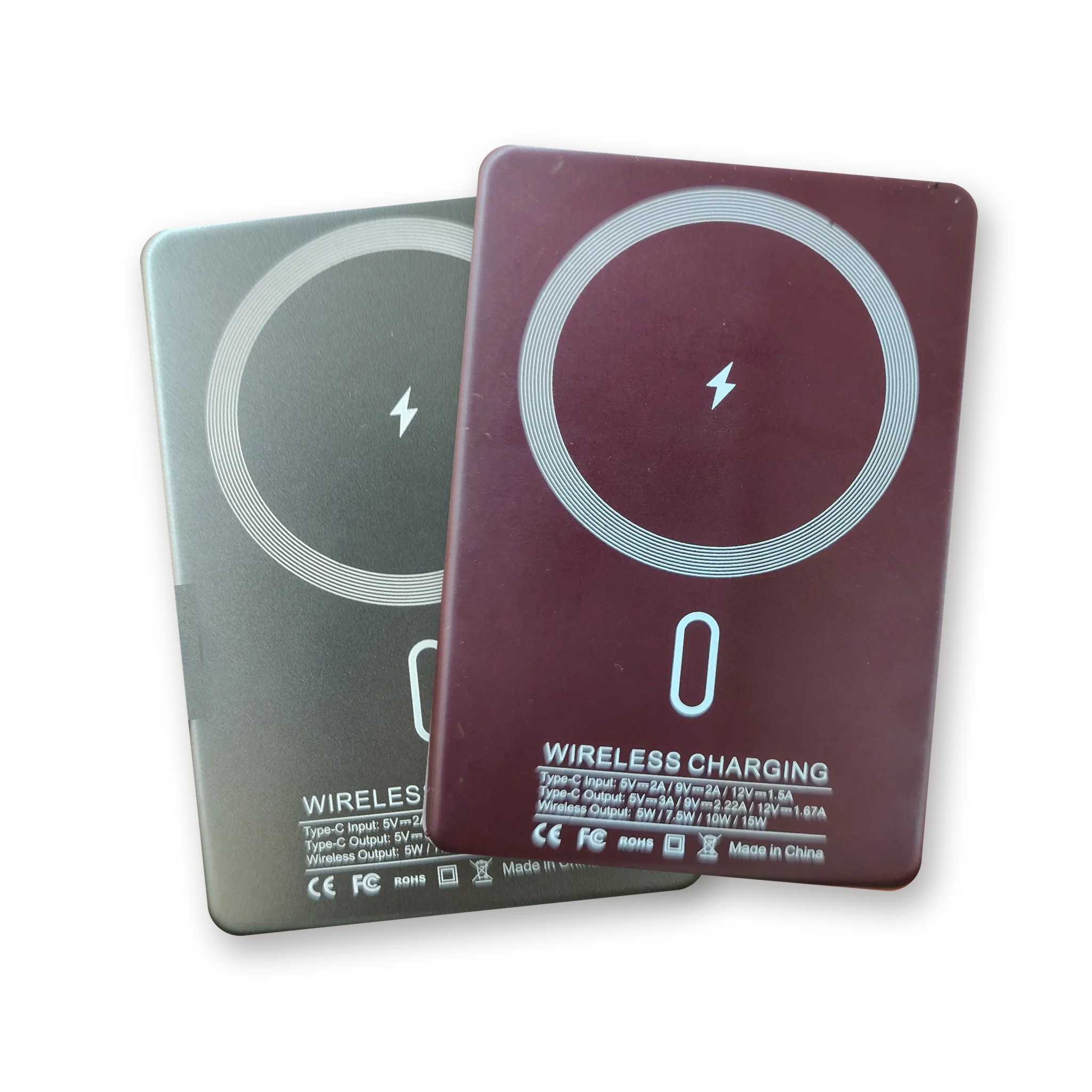
A magnetic battery pack is a small power bank with a ring of magnets and a wireless charging coil on its back. It snaps onto an iPhone, or onto a case with a matching magnet ring, and charges the phone wirelessly. When you do not need it, you pull it off and the phone goes back to its normal size.
The magnets do one important job: they hold the coil in exactly the right place. A wireless charger that sits a few millimetres off centre wastes energy as heat; a magnetically aligned pack lands in the same spot every time.
What is a battery case (charging case)?
A battery case — also sold as a charging case — is a protective phone case with the battery built into the back plate. The phone and the battery become one object. Most current models, including our Slim 2500, charge the phone through a Qi coil and add a USB-C port for wired pass-through charging.
Because the cell is laminated into the shell, a battery case usually carries more capacity per gram than a magnetic battery pack plus a separate case. The trade-off is that the extra thickness is there every day, whether you need the power or not.
Side-by-side comparison
These figures come from our own products. Charge added is calculated from the measured cell capacity for an iPhone 17 at 25 °C with the screen off.
| Spec | Battery case · Slim 3600 | Magnetic battery pack · Snap 5000 |
|---|---|---|
| Measured capacity | 3,500 mAh | 4,500 mAh |
| Charge added · iPhone 17 | ≈+53% | ≈+70% |
| Wireless output | Qi 15 W | Magnetic 15 W |
| Wired output | USB-C 22.5 W | USB-C 20 W |
| On the phone | All day | Only when needed |
| Wholesale · 500+ pcs | $13.90 | Price on request |
The magnetic setup wins on total capacity and on how thin the phone is on ordinary days. The battery case wins on simplicity and on thickness when the power is actually in use.
Efficiency: where the energy goes
Marketing pages often suggest that a magnetic battery pack is a newer and therefore better technology. It is not more efficient. Both designs lose energy in two places: converting the battery cell's voltage up to charging voltage, and pushing power through the wireless coil. On our bench the difference between a well-aligned magnetic pack and an integrated battery case is small; the bigger losses come from misalignment and heat.
If efficiency matters most, use the wired USB-C pass-through that most battery cases offer. A cable skips the coil entirely. We explain the numbers in detail in how much a 2500 mAh battery case really charges an iPhone.
Heat and battery health
Heat, not the format, is what ages a phone battery. Look for a magnetic battery pack or battery case that measures cell temperature and reduces power when it gets warm. Our cases drop from 15 W to 7.5 W above 45 °C. A product that never slows down is not faster; it is simply hotter.
Which one is right for you?
Daily commuters and heavy users
If your iPhone is below 20% by the evening most days, a battery case is the better buy. It is always charged, always attached, and adds the least weight per unit of energy.
Travellers and occasional heavy days
If you only run out on flights, conferences or weekends outdoors, a magnetic battery pack makes more sense. Use a bare iPhone or a thin magnetic case, and bring the pack only when the day will be long.
Retailers and distributors
Stock both. The two products serve different buyers and rarely cannibalise each other. A magnetic battery pack is also easier to sell across phone generations, because the pack does not depend on one exact phone shape. See our wholesale price ladder for mixed orders from 10 pieces.
Frequently asked questions
Is a magnetic battery pack bad for my iPhone battery?
No more than any other charger. What matters is temperature. Choose a magnetic battery pack that slows down when it gets warm, and avoid charging under a pillow or in direct sun.
Can I use a magnetic battery pack on any case?
Only on a case with a built-in magnet ring, or on a very thin case. Thick cases without magnets weaken the hold and push the coil out of alignment, which wastes energy as heat.
Which charges faster, a battery case or a magnetic battery pack?
Over wireless they are similar. A battery case with USB-C pass-through is faster when you plug in a cable, because the cable bypasses the wireless coil.
Can I take either one on a plane?
Yes, in your carry-on. Both are well below the 100 Wh limit for cabin baggage. Spare lithium batteries should not go in checked luggage.