The short answer
- It is a step between liquid and solid. A semi-solid-state cell keeps a small amount of liquid or gel inside a solid polymer matrix, instead of a free-flowing liquid electrolyte.
- It is harder to set on fire, not impossible. Less flammable liquid means fewer leaks and a higher temperature before thermal runaway starts. Protection circuits are still essential.
- Day to day, it feels the same. Charging, output and size are similar to a good lithium-polymer power bank.
- Ask for the same documents. UN 38.3, IEC 62133 and an SDS apply to semi-solid-state cells exactly as they do to any lithium battery.
How a semi-solid-state cell works
Every lithium-ion battery moves lithium ions between two electrodes through an electrolyte. In a standard cell, that electrolyte is a flammable liquid that soaks the separator. In a semi-solid-state cell, also called a quasi-solid-state cell, the electrolyte is mostly a gel: a polymer matrix that holds a small amount of liquid in place, sometimes with ceramic fillers added to improve stability.
A true all-solid-state battery would use no liquid at all. That technology is still largely in development; most batteries marketed as "solid-state" today are in fact semi-solid-state.
Semi-solid vs standard lithium-ion
| Point | Standard lithium-ion / polymer | Semi-solid-state |
|---|---|---|
| Electrolyte | Liquid | Gel in a solid polymer matrix |
| Leak risk | Possible if the cell is damaged | Lower |
| Thermal runaway | Starts at a lower temperature | Starts at a higher temperature, slightly less energetic |
| After puncture | Can vent or catch fire | More likely to stay stable |
| Cost | Lower | Higher |
| Transport rules | The same: lithium-ion battery, UN 38.3, carry-on only on planes | |
What is safer, and what is not
The main gain is in abuse situations: a power bank that is crushed, punctured, dropped hard or left in a hot car. With less free liquid, there is less to leak and less fuel for a fire, and test videos commonly show semi-solid cells surviving a nail puncture that would make a liquid cell vent.
The limits matter just as much. The gel still contains flammable material, so a semi-solid-state cell can still overheat after an internal short circuit or a badly designed charger. Overcharge protection, temperature sensing and a sound enclosure are as important as ever. A semi-solid-state label on a pack with poor electronics is not a safe product.
Regulators have not created a separate category either. For airlines, a semi-solid-state power bank is a lithium-ion battery like any other; see our guide to power bank rules on planes.
What changes in daily use
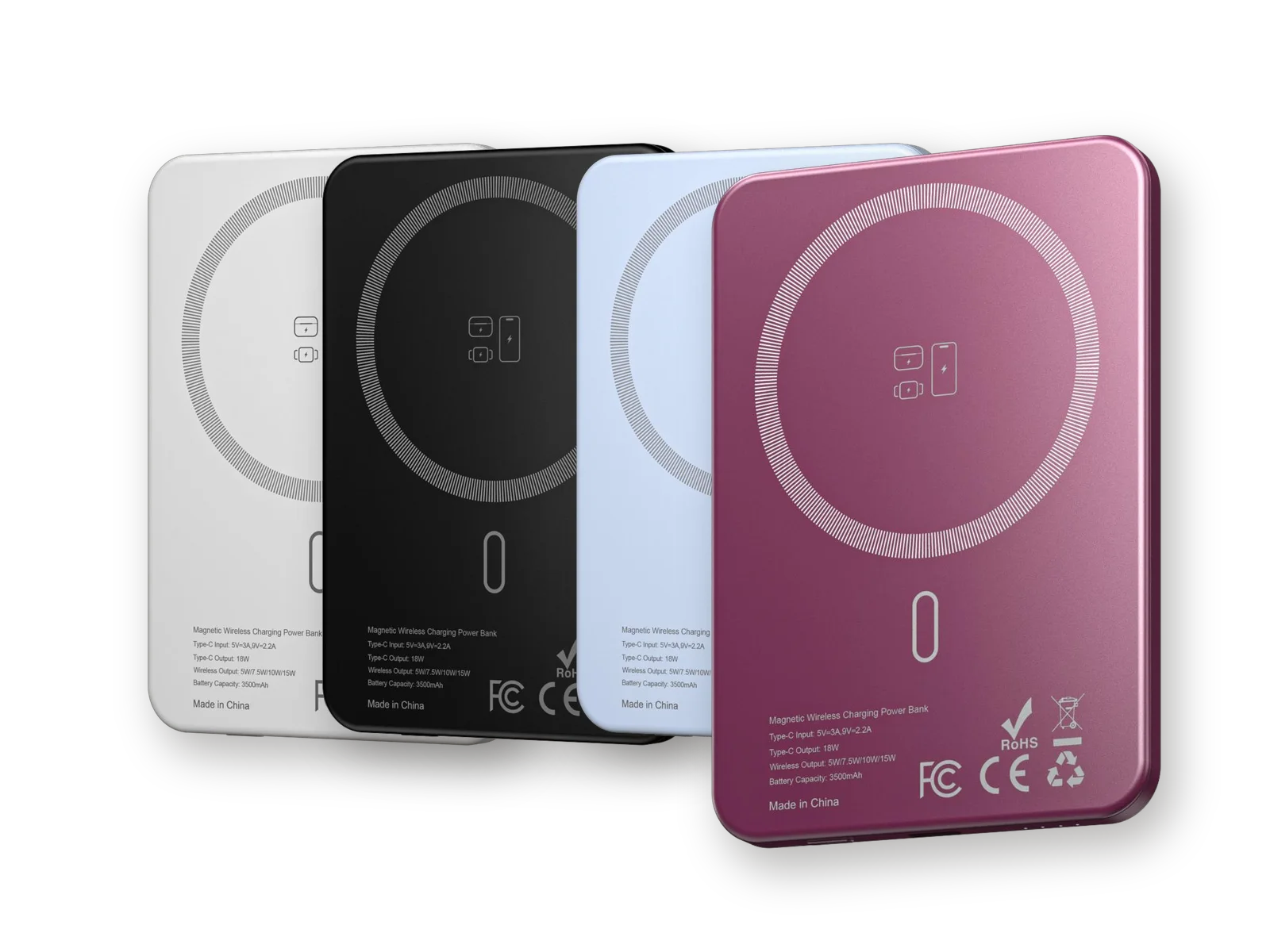
- Capacity and size: similar to a lithium-polymer pack. Our S54 fits 10,000 mAh into a 12.5 mm magnetic body, and the S58 adds a built-in USB-C cable.
- Charging speed: set by the charging electronics, not by the electrolyte. Wireless output is still up to 15 W on our magnetic models.
- Cold weather: some gel electrolytes conduct less well in the cold, so output can drop more noticeably below freezing.
- Price: expect to pay more than for a comparable standard pack.
What to check before buying
- The product states the cell type on the label or datasheet, not only in the marketing.
- The rated capacity is printed in mAh and Wh.
- The maker can provide UN 38.3, IEC 62133 and an SDS that name this cell.
- There is temperature protection and the pack stops charging when full.
- For travel in mainland China, the pack carries a clear 3C mark.
For retailers and importers
Semi-solid-state is a real selling point, especially for travel and for customers who worry about battery fires, but it should be described accurately. Claims such as "cannot catch fire" or "explosion-proof" are not supported and invite complaints. "Gel electrolyte for improved safety", backed by the cell report, is the honest version. For the documents behind such claims, see our certification guide.
Frequently asked questions
Is a semi-solid-state power bank fireproof?
No. It is less likely to leak or catch fire, especially after damage, but the gel electrolyte is still flammable. Good protection electronics remain essential.
Is semi-solid-state the same as solid-state?
No. A semi-solid-state cell still contains some liquid or gel; a true solid-state cell uses no liquid at all and is still largely in development.
Can I take a semi-solid-state power bank on a plane?
Yes, under the same rules as any lithium-ion power bank: carry-on only, up to 100 Wh without approval, and subject to your airline's rules on use during the flight.
Does a semi-solid-state power bank charge faster?
Not by itself. Charging speed depends on the electronics and the phone. The difference is mainly in safety and durability under abuse.